Case Study

Merphils In Progress

Merphils

Designing a unified education platform where schools, families, educators, and learners can move across roles without losing continuity.

EducationSaaSMulti-tenant

Project Overview.

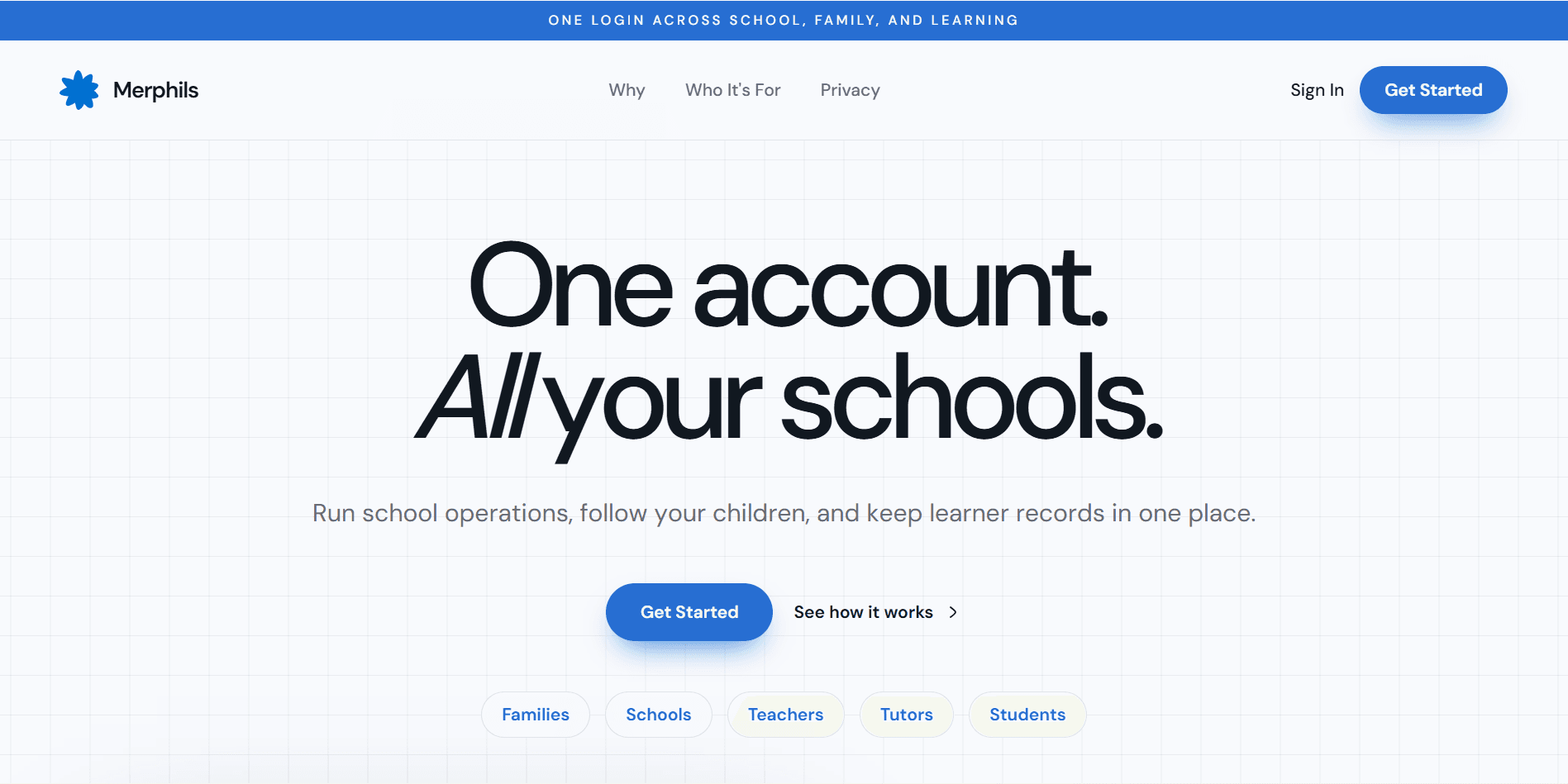
Merphils is a unified education platform designed to connect school operations, family access, learner records, and future cross-school collaboration in one system.

The product is built around a single-account, context-aware identity model that lets one person move across multiple schools and roles such as owner, staff member, parent, or student without creating duplicate identities.

It is being shaped to support class management, assignments, grades, admissions, finance, and long-term academic history while keeping school data private by default and learner continuity intact over time.

Goals.

  • Unify school operations, family access, and learner history in one platform instead of fragmented portals.
  • Make one account work across multiple schools, children, and roles while keeping school data private by default.
  • Lay the groundwork for future network features such as study circles, resource sharing, and tutor discovery.

From Idea To Launch.

A walkthrough of how the work moved from framing to execution.

01
Milestone 01Problem Discovery
Problem DiscoveryStep 01

Start where education platforms usually break: fragmented identity.

The core product decision was to treat identity as shared across schools, roles, and relationships rather than forcing separate accounts for every context.

That framing made it possible to design around one learner history, one family surface, and one person moving between roles like owner, staff member, parent, or student.

02
Milestone 02Constraint Mapping
Constraint MappingStep 02

Define access rules without losing continuity for the user.

The platform is being shaped around strict access boundaries so each school only exposes the information relevant to that context while still preserving continuity for the user.

The experience has to make context-switching feel simple for families and administrators without weakening privacy or permission controls behind the scenes.

03
Milestone 03Solution Direction
Solution DirectionStep 03

Turn school operations into product surfaces people can actually navigate.

The platform is being structured around the daily jobs schools and families need to complete, from classes and assignments to admissions, grades, and finance.

That keeps the product grounded in operational clarity instead of letting the access model become an abstract architecture exercise.

04
Milestone 04Platform Implementation
Platform ImplementationStep 04

Build today's school workflows without blocking tomorrow's network features.

Current product work is focused on the workflows schools need immediately, including classes, assignments, grades, academic history, admissions, and finance.

At the same time, the structure is being kept flexible enough to support future network features like tutor discovery, study circles, and resource sharing across education contexts.

05
Milestone 05Current State
Current StateStep 05

Push the platform toward a first cohesive operations release.

Right now the work is centered on tightening the relationship between identity, permissions, and the operational surfaces schools and families will use most often.

The immediate goal is to get the core school workflows feeling stable and coherent before broader collaboration features become part of the next phase of the product.

Results .

  • Established a clearer product direction around one account across schools, children, and roles.
  • Defined an access model that protects school boundaries while preserving learner continuity over time.
  • Created a platform foundation that can support school operations now and broader education collaboration later.

Reflection.

Education platforms break down when identity is fragmented. The real work is making continuity feel simple without weakening access boundaries.

More Work.

Explore the rest of the archive.